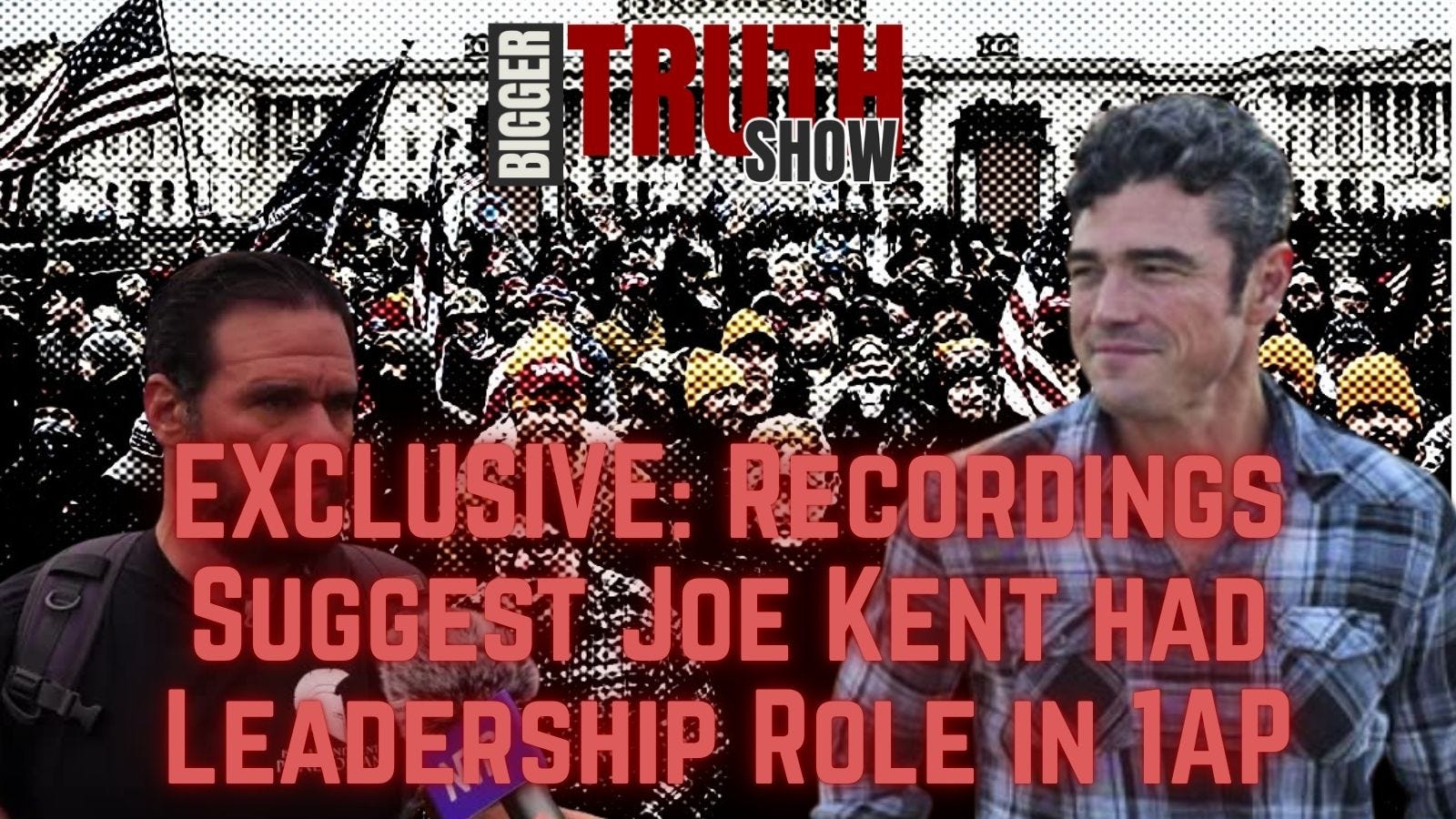
BREAKING EXCLUSIVE: Recordings show First Amendment Praetorian operatives viewed Joe Kent as top leadership along with Robert Patrick Lewis
1AP operative to Staci Burk about her stolen phone: "I didn't tell Yoda. I went directly to Rob and Kent with that phone." Part one in a new series: "Big lies and the Bigger Truth of 2020."
Three recordings from early 2021, obtained by Bigger Truth from Staci Burk, show 1st Amendment Praetorian (1AP) operatives she claims were detaining her under the guise of security in her Arizona home reporting the details of her case up a chain to “Rob and Kent”: Robert Patrick Lewis, the group’s co-founder, and Joe Kent, the man the Senate later confirmed to run the National Counterterrorism Center.
Kent’s link to the private militia that guarded Mike Flynn’s and Roger Stone’s 2020 “Stop the Steal” operation was adeptly speculated by Mother Jones. Kent amplified the group on Twitter. He and Lewis called each other “brother” in public Twitter conversations, shown in the screenshots below. These recordings go further. The operatives on the ground treated “Rob and Kent” as the top of the chain of command. One of them, Rich Chichester, reported the case of Burk’s stolen phone directly to them, over the head of his own team leader. A second 1AP man, James Curtis, said on a separate recording that Lewis “brought Kent in.”
The fallout they were reporting up that chain: Burk’s phone, which they admit in the recordings was stolen from her hands by an armed operative, before it surfaced at the Willard Hotel in Washington, D.C., blocks from the White House, in the first days of January 2021.
Joe Kent as the pro-BRICS insurgent
Kent is a former Green Beret who ran twice for Congress in Washington’s 3rd District and lost both times to Democrat Rep. Marie Gluesenkamp Perez. Trump nominated him to lead the National Counterterrorism Center on Feb. 3, 2025. The Senate confirmed him on July 30, 2025, by a 52-44 vote. He resigned on March 17, 2026, in protest of Operation Epic Fury, the joint U.S.-Israeli military campaign against Iran, with a letter declaring that “Iran posed no imminent threat to our nation, and it is clear that we started this war due to pressure from Israel and its powerful American lobby.”
Kent has since faced allegations of leaking. The FBI is reportedly investigating him in connection with alleged leaks of classified information. Separately, Turning Point USA spokesman Andrew Kolvet said on “The Charlie Kirk Show” in March that he provided Charlie Kirk’s private group-chat messages to Kent, then the sitting NCTC director; that Kent urged him to make them public; that Kolvet declined; and that the messages appeared weeks later, published by Candace Owens. “Can I 100% categorically say that he leaked them? No, but those are the facts,” Kolvet said. Kent denied leaking the messages: “I know I did nothing wrong.”
Kent’s resignation was widely interpreted as an act of subversion against President Trump’s efforts to permanently disarm Iran’s nuclear ambitions. Mike Flynn’s network has amplified Kent relentlessly since his resignation, making him a leading figure in the anti-Trump, anti-Israel insurgency on the right. Watching that unfold led me to ask whether Kent’s relationship with Flynn’s network had roots that predated his first run for Congress. The recordings in this report answer that question. Kent was involved in Flynn’s network by the end of 2020, and the operatives running one of that network’s most disturbing operations understood him to be leadership.
The public record of Kent and Lewis
On Sept. 10, 2020, Robert Patrick Lewis announced the launch of 1AP in a lengthy Twitter thread: “a group of military, law enforcement & intel community veterans” recruiting volunteers to provide “physical security, intelligence/surveillance and to serve as team leaders for small security & intelligence cells.” The thread’s final post ended: “Counterinsurgency activated.”
Joe Kent reposted the thread that launched 1AP, a fact first pointed out by Mother Jones. Kent and Lewis promoted each other on Twitter/X and repeatedly called each other “brother.” In a 2022 Telegram post, Lewis said he knew Kent “personally.” When Kent was appointed to NCTC, Lewis said he was “doing the happy dance rn” and posted a picture of Kent and Tulsi Gabbard to celebrate.


On Nov. 25, 2020, registration records show, the Shepherd Group, doing business as First Amendment Praetorian, registered as a federal contractor to provide “physical security” and “professional intelligence” services. Ten days earlier, a team of operatives in their network had begun assembling around Staci Burk.


Who is Staci Burk?
Burk was an Arizona woman drawn into Sidney Powell’s post-election case. In November 2020, men presenting themselves as a government-arranged security detail moved into her home, telling her that her life was in danger. Her federal court filings allege the detail controlled her communications and contact with the outside world for months. Two sworn affidavits from visitors to the house, one a licensed process server, describe armed men, a U.S. government contractor ID, and a woman who was not allowed to leave. That story, and the manufactured threat behind it, will be explained more fully in Parts 2 and 3 of this series.
What matters for this report is the phone. Burk’s phone held several hundred recordings of her conversations with 1AP operatives and with Flynn, Joe Flynn, Sidney Powell, Kelly Townsend, Bernie Kerik, and others. According to her filings, operative Brandon Pittman, while armed and standing with Rich Chichester, “forcefully took her phone from her hands while she was on a call with an Arizona Senator.” Days later, Geoffrey Flohr, the team leader code-named “Yoda,” who had deployed from her house to guard Flynn in Washington, sent Burk a photo confirming the phone had turned up at the Willard Hotel on Jan. 4, in the bag of operative Rich Chichester.


Weeks later, Burk’s lawsuits allege that a different phone, of the same model but a completely different color, was returned to her. It had been cloned, meaning her files, apps and recordings had been copied. However, according to the lawsuits, several key recordings of conversations with Mike Flynn, Joe Flynn, Sidney Powell, and others had been scrubbed. 1AP operative Mike Kenny sent Burk a copy of the shipping receipt for the return of her replacement phone.
Burk never received her original phone back.

The theft of that phone is the event the operatives had to explain to up the chain of command within the 1AP organization. The recordings show who they reported to.
“I went directly to Rob and Kent with that phone”
The first recording is a conversation between Burk and Chichester. In the 51-second excerpt below, published here for the first time, Chichester describes what he did with Burk’s phone, which he claimed Pittman planted in his backpack, the same backpack that had traveled with him from her house in Arizona to the Willard Hotel in Washington. He did not report it to Geoffrey Flohr, the team leader code-named “Yoda.” He went over Flohr’s head, to the top.
“I didn’t tell Yoda,” Chichester says. “I went directly to Rob and Kent with that phone. I thought somebody had tracked me home. I didn’t think it was your phone.”
Chichester was a field operative for 1AP with Yoda as his team leader above him. When he found stolen property in his own bag and feared he was being set up, the two men he trusted with it, bypassing his entire team structure, were Robert Patrick Lewis and Joe Kent.
The investigation: “Rob... put out the questions”
The second recording is a separate, longer conversation between Burk and Chichester. Three excerpts, published below, capture his account of what happened after the theft reached the top: an internal 1AP investigation into the stolen phone, run by “Rob and Kent.”
In the first excerpt, Chichester describes leadership’s reaction when he contacted them. “I think when I contacted Rob and Kent, see I don’t think Rob and Kent really knew what was going on,” he says. “Because Rob, when he put out the questions for me and 1800,” the call sign for Brandon Pittman, the operative Burk’s lawsuit accuses of grabbing the phone from her hands, “he said, we didn’t know, he says, I didn’t know this phone was stolen. Okay. When was it stolen? And what happened? And I told him. I said Yoda knew it was gone. Yoda knew the whole thing.”
In the second excerpt, Chichester describes the paper trail. He wrote an after-action report on the deployment. Protocol said it went to Yoda: “my AAR was supposed to be written to Yoda, okay, because he was the boss.” He copied Pittman, the team leader. But because he did not trust Flohr to pass it up, he made sure it reached the two men above him: “I didn’t trust Yoda. And I didn’t know whether he would pass it on to Rob and Kent. So what I did was I blind copied Rob and Kent.”
“I was gonna tell Rob and Kent no matter what, and I did that,” he says. What followed, in his telling: “I think it was Rob and Kent talking to Yoda and saying, what the hell is going on here? That created the chaos.”
In the third excerpt, Burk asks Chichester directly what Rob and Kent said about the theft. His answer catches how busy leadership was in the run up to January 6: “we still had the big thing that was going to be happening in DC. Okay? And so they were like really busy at the time.”
Chichester describes sending recordings to leadership as evidence in the investigation, including a tape Burk had given him of Pittman disparaging him. Burk tells him leadership’s response was to blame her for sending it. “That’s the thing that blows my mind,” Chichester answers. “And I think that’s more Kent than anything. I don’t know what Rob is... I’m looking at leaving the group anyway.”
The excerpts also catch the operatives’ understanding of accountability inside the group. “The people who give the orders, usually are not the ones that end up in trouble,” Chichester tells Burk. “It’s the peons that do the dirty work.” By his account, the fallout landed on the peons: Chichester and Pittman were suspended from the group’s encrypted Wickr rooms, and Flohr left.
Chichester also says this: “I don’t think Rob and Kent really knew what was going on.” In his account, the theft itself was run at the team level. What the recordings establish is the structure above it. When something went wrong in the field, the man on the ground went around his team leader to “Rob and Kent,” the two men with the authority to put out questions, demand answers, and hand down suspensions.
Lewis “brought Kent in”
The third recording corroborates the structure from another direction. James Curtis, a second 1AP man, describes communications with Lewis about the phone and says Lewis “brought Kent in.” Curtis also tells Burk that an audio file exists of Pittman “getting direction from Yoda before the phone was stolen, directing that the phone be stolen,” and gives his own assessment of the team: “I think Yoda’s corrupt, 1800 is corrupt, and I don’t know where the rest of it goes.”
No prosecutorial interest
The January 6th Committee obtained initial discovery from 1AP, provided by the group’s lawyer, Leslie McAdoo Gordon, including a list of members and whether any held current .gov or .mil email addresses. The committee deposed Lewis, who invoked the 5th Amendment as he refused to answer nearly every question asked of him. Despite this, and Lewis’ own public statements prior to the event saying “we have the constitutional authority to go physically rip them out of their offices tie them down to a railroad tie and run them out of town,” neither Lewis nor any other operative of 1AP were prosecuted for J6-related crimes.
Further, no public record shows the Committee, the FBI, or the Senate ever asking what these recordings now raise: what was Joe Kent’s role in this organization in the winter of 2020-21?
Kent’s own sworn Senate questionnaire, submitted for his 2025 confirmation to run the nation’s counterterrorism enterprise, does not mention involvement in 1AP.
Messages seeking comment from Kent and Lewis were not returned.


